A job advert asks for your resume. Every employer you have ever applied to in the UK asked for your CV. Are they asking for the same thing, or something different? The short answer is that it depends where the job is, and getting it wrong can cost you the interview. It is the first question a cv resume writing service hears from people applying across borders, and the answer is simpler than the two words make it sound.
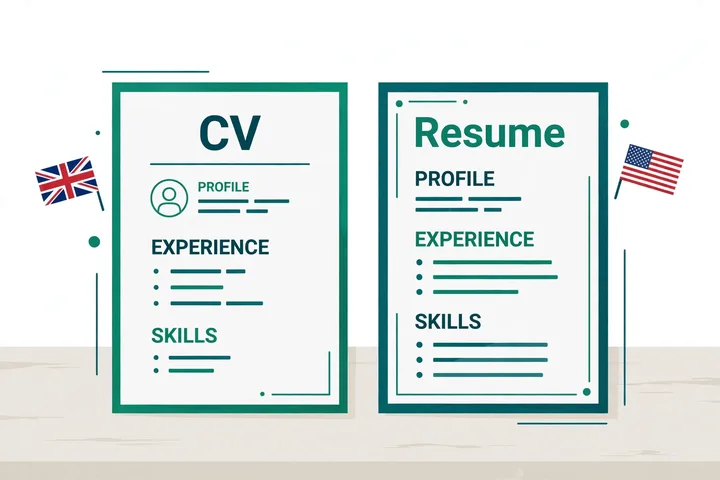
In the UK, a CV and a resume are the same document with different names. In the US, they are two different documents. And in universities, CV means a third document altogether. Once you know which of the three the employer means, the rest is straightforward: the length, the spelling, the sections, even the paper size all follow from that one choice.
What is a CV?
CV is short for curriculum vitae, Latin for course of life. In the UK it is the standard document you send when you apply for a job, from a Saturday job in a shop to a director role. The National Careers Service lists the sections it should have: your contact details, a short introduction, your education history, your work history and references. It also says what to leave out: your age, your date of birth, whether you are married and your nationality. A UK CV runs to two A4 pages at most, and one page is enough early in your career. A cv resume writing service working in the UK builds every CV to that shape, because that is what British employers expect to see.
The top of a UK CV is a personal statement, a few short lines under your name that say who you are, what you have done and the kind of role you want next. Under that comes your work history, newest first, then education, then skills. Your degree class goes in, a 2:1 or a first, and so do your A levels and GCSEs if you are early in your career. References go at the end, or a line saying they are available on request. Nothing in that list is decoration. Each section answers a question the employer is asking, and each one is written for the job in front of you, not copied from the last application. It is the first thing a cv resume writing service looks for in a draft, because a CV written for one job rarely fits the next.
What is a resume?
A resume is the American word for the same short job document. It comes from the French word for summary, and that is what it is: a short summary of the experience and skills that matter for one job, usually one page, two at most for someone with long experience. It opens with a short summary, then work experience, education and skills, newest first. No photo, no date of birth, no marital status, just like a UK CV.
The differences are small but they matter. A resume uses American spelling, organise becomes organize, programme becomes program, centre becomes center. Dates are written Jan 2024, not January 2024, and the paper is US Letter, not A4. Education lists a degree and a GPA, not a degree class and A levels. And a resume never lists references. If you send a UK CV to a US employer unchanged, the spelling alone tells them you did not write it for their market, and a one page resume from someone with ten years of experience reads as thin in the UK for the same reason. That is the kind of detail a cv resume writing service checks first when it converts a document from one market to the other.
CV vs resume in the UK
So what does CV vs resume mean in the UK? For almost every job, nothing at all. British employers ask for a CV, and the CV they mean is the two page document above. The word resume is rarely used in British hiring, and when it appears in a UK job advert it usually means the same thing. Imperial College London careers service puts it plainly: in the UK the two terms mean the same thing, and CV is the more common one. If a London employer asks for your resume, send your CV. Do not write a new document, and do not shorten it to one page to match the American habit. The employer wants a UK CV under an American label.
Read the table below from left to right and the pattern is clear. The US resume and the UK CV are the same kind of document, written to different local habits. The academic CV is a different animal, and that is where people get caught out. If the table leaves you unsure which version you hold, a cv resume writing service can read your document and tell you in one pass.
| US resume | UK CV | Academic CV | |
|---|---|---|---|
| Who asks for it | Most US employers outside universities | Almost every employer in the UK | Universities, research labs, fellowship panels |
| Usual length | One page early in your career, two pages with long experience | One or two A4 pages, two is typical | No set limit, it grows with your career |
| What goes in it | Chosen experience, skills and results for one job | Profile, experience, education, skills, references | Everything: publications, grants, teaching, talks, awards |
| Opening section | Short professional summary | Personal statement of a few short lines | Education, then research posts |
| Spelling | American English | British English | Either, matched to the employer |
| Paper size | US Letter | A4 | A4 or US Letter |
| Photo | No | No | No |
| References | Left off | Listed, or available on request | Listed in full |
The third document: the academic CV
In the US, and in universities everywhere, a CV can also mean a full record of an academic career. It has no page limit. It lists every publication, every grant, every course taught, every talk given, newest first, and it grows as your career grows. A senior professor’s academic CV can run to twenty pages. Nobody sends that document for a job in a bank or a hospital, and nobody should. It exists for faculty posts, research roles, fellowships and grant applications, anywhere the employer needs your whole scholarly record rather than a short pitch for one job.
The mistake is sending the wrong one. A six page academic CV sent to a company recruiter reads as if you cannot tell what matters, and a one page resume sent to a university department for a research post reads as if you have nothing to show. Before you send anything, read the advert again. Words like full CV, list of publications and references point to the academic version. Words like two pages, personal statement and apply now point to the job document. If the advert still leaves you guessing, ask the recruiter. One short email beats a wrong document, and a cv resume writing service will tell you the same: the advert decides, not the label.
Which one do UK employers expect?
A UK employer expects a CV, two A4 pages, British spelling, a personal statement at the top, work history in reverse order, and no photo, date of birth or marital status. That is the whole answer for most readers of this guide. The National Careers Service and Prospects agree on the shape, and the University of Edinburgh careers service calls the two page CV standard for the UK. Keep the font plain, Arial or Calibri at size 11 or bigger, one column, standard headings like Experience, Education and Skills, and save it as a text based PDF or a Word file. An applicant tracking system reads the file, not the label, so a CV and a resume with the same layout parse the same way, and a two column design with graphics will trip the parser whatever you call the file. It is also the first thing a cv resume writing service checks on a UK CV, before it reads a single bullet.
There are two exceptions worth knowing. The first is the NHS, where applications are scored against set criteria and a plain CV is often not enough on its own. The second is acting and modelling, where a photo is part of the application. For every other job in the UK, the rule above holds. That is also why a cv resume writing service asks where you are applying before it writes a word: the market decides the shape. If you are applying from outside the UK, add one more line: a clear note about your right to work, such as a UK address or a visa note, because that is one of the first things a British recruiter checks.
When to use each one
Use this as a rule of thumb, and let the job advert overrule it every time. Applying for a job in the UK, Ireland or most of Europe: send a CV, one or two A4 pages, British spelling. Applying for a corporate job in the US or Canada: send a resume, one page if you are early in your career, two if you have long experience, American spelling, US Letter paper. Applying for a university post, a research role or a fellowship anywhere in the world: send a full academic CV, with your publications and grants in full. A cv resume writing service can build all three from one master document, so you never start from a blank page.
Converting between the first two is a small job, not a rewrite. Keep one long master document with everything you have done, then cut a fresh copy for each application. To turn a US resume into a UK CV, change the spelling, stretch it to two pages, rename the summary a personal statement, write the dates out in full, and add your A levels and references. To turn a UK CV into a resume, cut it to one page, drop the A levels, change the spelling back, and take the references off. The experience stays the same. Only the local details change, and that is the part people forget. A cv resume writing service that handles cross border applications does exactly this conversion, and it starts from the advert, not from the old document. If you want the whole job done for you, our CV writing services page sets out what a full rewrite includes.
Five mistakes that mix the two up
The first mistake is sending a one page CV for a senior UK role. In the UK, two pages is the norm for anyone with experience, and one page reads as junior. The second is American spelling on a UK application. Recruiters notice it at once, and it reads as if the application was not written for them. The third is sending an academic CV for a company job, six pages where two would do. The fourth is a photo, a date of birth or a full street address on either document, in either country. The fifth is using the same file for every job. The advert tells you what to keep, and a CV that ignores it will lose to one that does not. Each of these is a small fix, and each one is easy to miss when you are the person who wrote the file. That is the real value of a second pair of eyes, whether it is a friend reading it over or a cv resume writing service checking it against the advert.
Frequently asked questions
Is a CV the same as a resume in the UK?
Yes. In the UK the two words mean the same document, a one or two page summary of your skills and experience, and CV is the word employers use. In the US they are different: a resume is the short job document and a CV is the long academic record.
Should I send a resume or a CV for a UK job?
Send a CV. Keep it to two A4 pages, British spelling, a short personal statement at the top, and no photo, date of birth or marital status. If the advert says resume, send the same CV. The employer means a UK CV.
How long should a CV be in the UK?
Two A4 pages is the standard, and one page is enough early in your career. A third page rarely earns its place. An academic CV is the exception: it has no page limit and grows with your career.
What is an academic CV?
A full record of an academic career: education, research, publications, grants, teaching, talks and awards, newest first. It is used for university posts, research roles and fellowships, not for company jobs.
Do I need a photo on my CV or resume?
No, not in the UK or the US. Employers in both countries avoid photos because they can reveal age, race or gender. A few countries in Europe still expect one, so follow the job advert and local habit.
Can a CV writing service convert my resume into a UK CV?
Yes. A cv resume writing service can reshape a US resume into a UK CV, changing the spelling, the length, the paper size and the sections, while keeping your experience the same. A resume and cv writing service does the same work under either name, so ask for the UK version and check the result against the advert. If you only want to know what needs changing, start with a free CV review and fix the rest yourself.
CV and resume are two words for the same idea, until you cross an ocean or walk into a university, and then they are not. In the UK, send a CV. In the US, send a resume. For an academic post, send the full record. Get those three right and the rest is detail: spelling, paper size, two pages, no photo. If you would rather have someone else do the converting, a cv resume writing service can reshape your document for the market you are applying to, and a free CV review is the simplest way to find out what your current CV is missing before you spend anything. Either way, send the document the employer asked for, in the shape they expect, and let your work do the talking. If you want the whole job done for you, our professional CV writing page sets out what a full rewrite includes.
Leave a Reply